Don’t Let the Valley of Despair Kill Your Dream

Photo by Ryan DeWerff on Unsplash
Have you ever started a new venture with excitement and unbounded optimism, only to find yourself months or years later wondering if you made a mistake?
A bold staff restructuring effort. A new fitness and nutrition plan. A visionary program idea for your nonprofit. A one-year Bible reading plan.
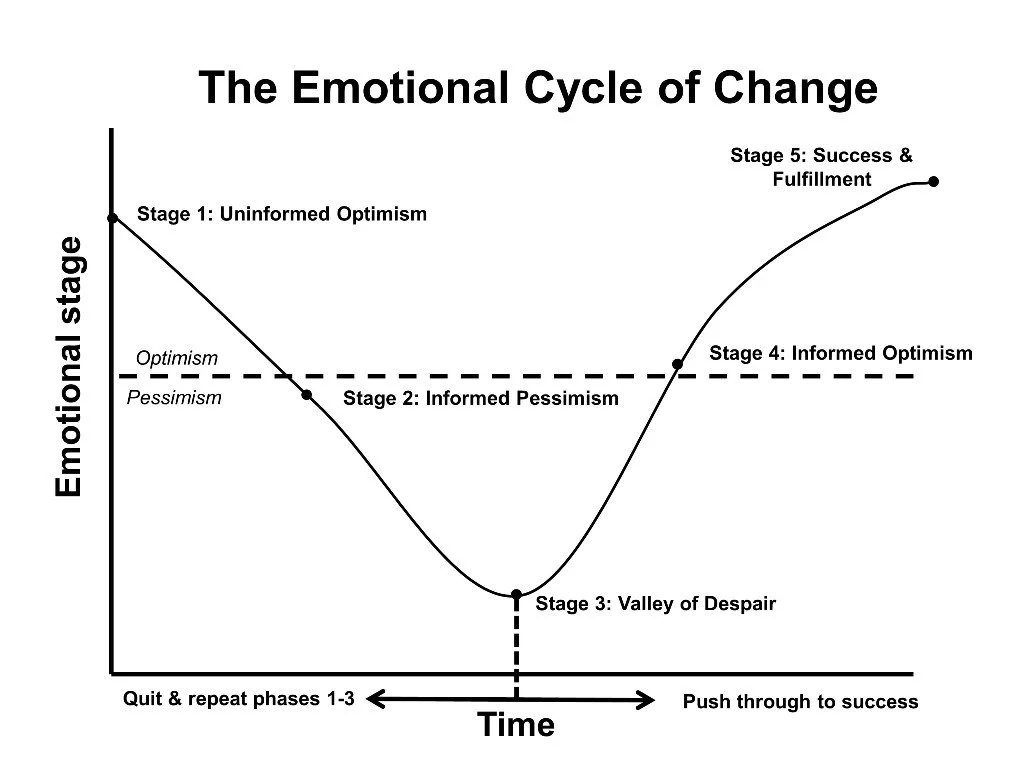
One of my all-time favorite charts to describe the roller coaster of a founder's emotions was developed by Don Kelley and Daryl Conner. It is known as the Emotional Cycle of Change and was first published in 1979 in a handbook for group facilitators.
The chart tracks the progress of emotions over time as you progress through the various stages of growth and change.
I have lived through this cycle so many times that it is now easier to spot the state of my emotions and understand how they correlate to a given stage.
Understanding this cycle has helped me recognize something important: when things feel difficult, it doesn't necessarily mean the vision is wrong. Sometimes, you simply need to be patient enough to keep going.
In my book, Unlikely Good, I outline three phases of doing new work: dream, discern, deliver. Simply put, there is an orderly process where an idea is conceived, refined, and executed. The chart I’m referencing can help you understand the emotional roller coaster we all experience as we walk through those stages.
Stage 1: Uninformed Optimism
In the dream phase of your work, you are stepping out at Stage 1: Uninformed Optimism.
You are ignorant, but it is blissful ignorance. You don't know what you don't know. Debbie Downer hasn't rained on your parade just yet.
This is often where the vision begins. You're excited about what could be possible, even though you haven't yet experienced all of the challenges that will come with pursuing it.
I have seen my share of nonprofit visionaries at this stage: starry-eyed and hopeful. I don’t want to crush their dreams, but their optimism is uninformed because they have not executed anything yet.
I was once so excited to try one of those promising, new nutrition plans. It seemed to hold great promise for helping me meet my fitness goals. That is until I experienced the suggested dinner plan for day one: pretend the cauliflower you are about to eat is mashed potatoes.
Stage 2: Informed Pessimism
As you progress into the discern phase of the work, you transition to Stage 2: Informed Pessimism.
As you get started, you begin to understand the time, commitment, and resources the new effort will require.
The obstacles are clearer, but you do not feel defeated just yet.
As you progress into the deliver phase of the work, you may find yourself alternating between the first two stages. Your early wins can help you regain optimism. The struggles will tug you toward more pessimism.
This back-and-forth is part of the process.
But with enough time under your belt, you may find yourself entering the most difficult stage of all.
Stage 3: The Valley of Despair
The Valley of Despair is where things feel the bleakest.
As you operate the new school, the work with students is going well, but your bookkeeper has to remind you of the limited number of payrolls you can afford.
The once-promising employee has now turned against you and resigned.
The family leaves your school because you don't have the sports programs they want.
The church members with positive energy are now at each other's throats.
You struggle to get police departments to even meet in the same room.
These are the moments when you begin to question whether the vision you started with is actually possible.
The Valley of Despair is where nonprofit founders, church planters, and business entrepreneurs go to die. The Valley is where most people throw up their hands and quit.
I can remember being in the valley when I was starting a new church. The whole build-up to planting a church was so exciting. Our team was excited to see God change lives and for people to find hope in the Good News of Christ. Our first Sunday services were fun, even exciting, as new people started showing up. I was energized by preparing sermons and delivering them to the church.
Fast-forward to the summer months. Church attendance wanes as people take vacations. Attendance dips to seemingly unsustainable levels. That heartfelt sermon you wrote to move people—well, no one is there to experience it. Volunteers grumble about the lack of help.
I would be lying if I said there were not moments I wanted to quit.
The thing that kept me going was my faith in Christ, the same faith that inspired our team to reach new people with the Good News. And so we kept pushing even when it was hard.
It is vital that you are able to recognize when you find yourself in the Valley of Despair before you get there.
A newly planted fruit tree doesn’t produce fruit right away.
Before any fruit emerges on a tree, the roots have to go down to anchor the plant and absorb nutrients. In time, those roots will produce a shoot that goes upward above the ground.
When you are in the Valley of Despair, it will be helpful to visualize this analogy.
There may be a lot happening beneath the surface that you cannot see yet.
The roots are growing.
The plant is getting anchored in the soil.
Growth is occurring, even if there is little visible evidence of it.
This is where patience becomes so important.
Stage 4: Informed Optimism
Eventually, if you stick with it, you can start building a cycle of success and live to witness Stage 4: Informed Optimism.
Now you know more than you did before, and you are not just a cynic. You realize that success can and does happen.
You may experience more success than failure.
Jim Collins refers to this as the Flywheel Effect. It isn't a single big win that gets you here, but rather lots of small wins stacked on top of one another.
This is why it is so important to recognize and celebrate your early wins.
You stayed on your fitness and nutrition plan for one week. You found a new donor. One employee was excited by the reorganization effort.
Those early wins may not feel like much when they happen. But over time, they can become momentum.
Stage 5: Success & Fulfillment
Once the flywheel gets spinning, you have momentum that takes you to Stage 5: Success & Fulfillment.
You can finally look back and see how far you've come.
You realize that the obstacles you encountered along the way were not necessarily evidence that the vision was impossible. They were part of the journey.
And you realize that it wasn't a single big win that got you there.
It was lots of small wins stacked on top of one another.
Be Patient With the Process
I have lived through this cycle so many times that it is now easier to spot the state of my emotions and understand how they correlate to a given stage.
That awareness is important.
When you understand that the Valley of Despair is part of the process, you may be less likely to interpret a difficult season as the end of the story. You might be less prone to quit when the effort gets hard.
If you are pursuing something that seems unlikely right now, remember that success is not achieved overnight.
It takes patience.
Stack up your early wins.
Tell the stories not just in the early days, but every day.
Stick with it when you hit the Valley.
And remember the tree.
Before you see the fruit above the ground, the roots have to grow deep.
Don’t forget your vision. Find ways to constantly renew your excitement for it. Keep your faith!
Brighter days are on the way.
What seems unlikely today may simply need more time to grow.